Belgian Winter Car Care 2026: Salt, Paint, and New Rules
As of late September 2026, preparing a vehicle for the harsh realities of a winter in Flanders requires a different approach than in previous years. Traditional seasonal maintenance is no longer sufficient on its own. Modern vehicle ownership now demands navigating an intersection of automotive chemistry and a shifting administrative landscape.
Key Takeaways
- Passenger cars in Flanders have been inspected every two years since September 1, 2026.
- The reinspection window for serious defects was extended from 15 days to two months.
- Tow-hitch mounting no longer requires a separate technical inspection.
- A €107.16 annual circulation tax (indexed annually on July 1) for zero-emission vehicles applies from January 1, 2026 (vehicles registered by December 31, 2025, are exempt). A separate one-time registration tax (BIV/TMC) of €61.50 also applies to zero-emission vehicles first registered from January 1, 2026.
- Planned low emission zone (LEZ) tightening was cancelled as of January 1, 2026.
Achieving true winter readiness this season requires mastering both the physical protection of the vehicle and a meticulous review of regional compliance standards. By adopting advanced surface care techniques and understanding the latest Flemish regulatory frameworks, motorists can preserve their vehicle's structural integrity while avoiding unexpected administrative penalties during the most demanding driving season of the year.
How Should You Balance Physical and Administrative Winter Prep?
To comprehensively protect a vehicle this season, motorists should adopt what can be defined as the "Dual-Winter Checklist." This framework divides seasonal preparation into two distinct but equally critical operational streams: Physical/Chemical Defense and Administrative Compliance.
The Baseline Mechanical Requirements
Before advancing to paintwork preservation or regional tax compliance, the vehicle must meet foundational safety standards. According to a winter car maintenance checklist by Continental, a complete routine mandates several specific physical inspections:- Fit dedicated winter tires designed for low temperatures.
- Check the precise condition and tread depth of those winter tires.
- Check all vital engine fluids.
- Check the battery for optimal cold-cranking capacity.
- Check the external lights for visibility in low-light conditions.
- Check the wiper blades for deterioration.
- Prepare a dedicated winter car kit for emergency situations.
Bridging Mechanics and Compliance
Once these baseline mechanical parameters are secure, the Dual-Winter Checklist forces a pivot toward advanced protection and compliance. The physical stream prioritizes chemical treatments—specifically utilizing specialized waxes and decontaminants to shield delicate clear coats from environmental degradation.Simultaneously, the administrative stream requires verifying the vehicle's legal standing under Flanders' newly enacted inspection regulations. Balancing this timeline alongside proactive chemical maintenance forms the core strategy for successful winter driving in 2026.
How Do You Remove Road Salt Without Damaging the Clear Coat?
Winter driving exposes a vehicle to severe chemical stress. Leaving saline road film on the bodywork for too long is inherently harmful; according to Maniac Auto, road salt in winter actively damages the bodywork, the underbody, alloy rims, exterior plastics, and rubber seals. To combat this, standards applied by French detailing experts such as Maniac Auto and Avatacar should be adopted to prevent permanent degradation.
Why Brushing Salt-Covered Paint Causes Micro-Scratching
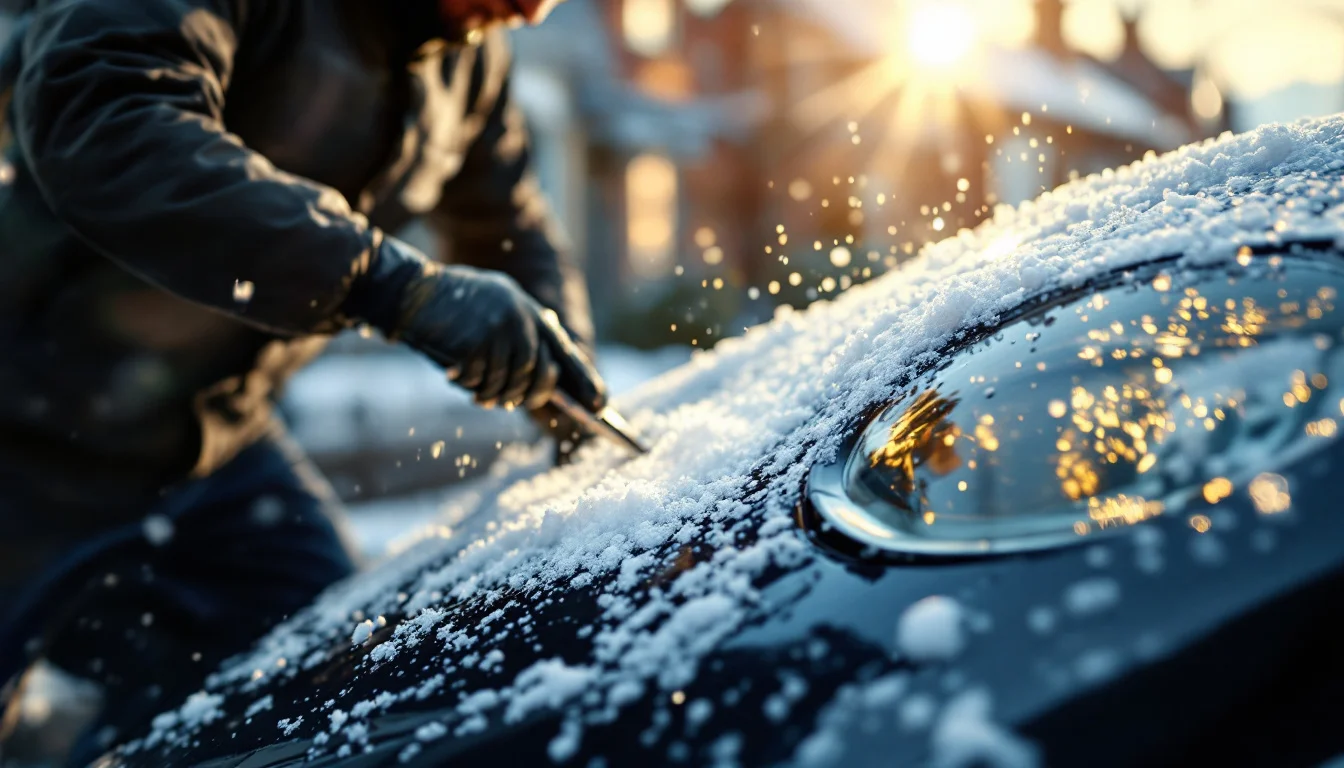
The instinct to quickly remove salt at an automated car wash can be destructive. Avatacar experts warn that brush or roller car washes must not be used when the car is covered in salt crystals. Mechanical agitation against these sharp crystals causes the brushes to inflict thousands of micro-scratches, permanently damaging the clear coat.Similarly, mechanical intervention on glass is discouraged. Maniac Auto advises against using ice scrapers on windows where possible. The glass surfaces are frequently dirty beneath the frost, meaning that the act of scraping can grind abrasive dirt particles against the glass, potentially causing micro-scratches. Furthermore, scrapers can inflict direct damage to the surrounding sensitive surfaces.
Advanced Decontamination and Protection
Instead of abrasive contact, modern detailing relies on targeted chemistry. To safely address the saline buildup on the bodywork, a Traffic Film Remover (TFR) should ideally be sprayed on the lower sections of the vehicle before rinsing. Maniac Auto emphasizes that this pre-treatment effectively lifts the saline film that aggressively adheres to the paint, allowing it to be rinsed away without mechanical friction.Following a safe wash, applying a physical barrier is crucial. Autoworld notes that spray wax is an easy and quick way to protect a car's paint during winter. Applying a layer of wax successfully shields the bodywork from dirt, salt, snow, and ice. This proactive chemical barrier preserves the vehicle's aesthetic shine while preventing deep structural damage from corrosive elements.
Winter Surface Care Comparison
| Method | Impact on Vehicle | Expert Recommendation |
|---|---|---|
| Ice Scrapers | Can drag dirt to cause micro-scratches and damage surrounding surfaces | Discouraged by Maniac Auto |
| Brush Automated Wash | Inflicts micro-scratches via salt crystals | Must not be used on salt-covered cars (Avatacar) |
| Traffic Film Remover (TFR) | Lifts saline film without mechanical friction | Ideal pre-treatment for lower vehicle sections |
| Spray Wax | Shields bodywork from dirt, salt, snow, and ice | Easy and quick proactive barrier (Autoworld) |
Which Winter Fluids Actually Need Checking?
While exterior chemical protection preserves the vehicle's structural and aesthetic integrity, internal thermal management dictates operational reliability during a freeze. A rigid approach to fluid diagnostics is an essential component of the physical preparation stream.
Managing Engine Coolant
Engine coolant serves a dual purpose: preventing the block from freezing in sub-zero ambient temperatures and inhibiting internal corrosion. Routine inspection of this fluid requires precise visual verification rather than blind top-ups.According to guidance from Febiac, drivers must actively check the expansion tank to determine whether the existing coolant is blue or pink. Crucially, if fluid levels are low, drivers must only add a product of the same colour.
Mixing different coolant specifications—often distinguished by these distinct blue and pink dyes—can trigger adverse chemical reactions. Such interactions compromise the fluid's freezing point and its anti-corrosive properties, potentially leading to severe mechanical failures when temperatures drop below freezing. Ensuring chemical uniformity in the expansion tank is a fundamental step in winterizing the internal combustion engine.
What Changed in Flanders' Technical Inspection on September 1, 2026?
Beyond physical and chemical maintenance, winter preparation in late 2026 demands strict attention to recent regulatory shifts. Earlier this month, Flanders implemented sweeping changes to its vehicle compliance framework, fundamentally altering the technical inspection calendar for motorists.
The Shift to Biennial Inspections
As of September 1, 2026, passenger cars in Flanders are officially subjected to the technical inspection every 2 years, according to a September 2026 framework by the Flemish Government (Vlaanderen). This transition applies to all passenger cars; the biennial interval had been introduced progressively in phases (September 1, 2024, July 1, 2025, and July 1, 2026), and from September 1, 2026, it covers the entire passenger-car fleet. Note that the extended interval applies only if the vehicle is presented for inspection from September 1, 2026 onwards and still holds a currently valid certificate at the time of that inspection (this prior-certificate condition does not apply to cars under 4 years old). The first technical inspection for a passenger car remains due when the vehicle reaches 4 years of age from its first registration.Extended Reinspection Windows
The September 2026 framework also introduced a highly practical change regarding mechanical failures. Vlaanderen confirms that in the event of a serious defect, the vehicle must now be presented again for inspection within 2 months.This is a significant operational relief, as the old deadline was 15 days. For drivers who discover severe mechanical issues right at the onset of winter—when spare parts are often delayed and repair shops are heavily booked—this extended two-month window provides vital breathing room to secure necessary repairs without losing road legality.
Tow Hitch Exemptions for Winter Sports
Preparing a vehicle for winter holidays frequently involves installing external cargo equipment to transport skis or additional luggage. Under the previous regime, such modifications necessitated an immediate, time-consuming administrative hurdle.Fortunately, Vlaanderen notes that starting September 1, 2026, the mounting of a tow hitch no longer requires a separate technical inspection. This regulatory simplification allows drivers to quickly equip their vehicles for winter sports travel without scheduling an intermediary compliance check, streamlining the final stages of winter trip preparation.
What Taxes and LEZ Rules Apply to Flemish Drivers in 2026?
The final pillar of the 2026 winter preparation strategy involves adjusting to fiscal realities already in force. Navigating the cost of vehicle ownership this season requires understanding diverging tax policies impacting modern electric platforms and older internal combustion engines.
The New Financial Landscape for EVs
Electric vehicle owners must budget for new recurring and one-time liabilities. According to Vlaanderen, starting January 1, 2026, zero-emission vehicles (running entirely on electricity or hydrogen) registered in Flanders pay a fixed annual circulation tax of €107.16 (additional centimes included). The amount is indexed annually on 1 July. In addition, a one-time registration tax (BIV/TMC) of €61.50 (not indexed) is due upon first registration from January 1, 2026.There are strict parameters governing these new taxes:
- They do not apply to (combined) vehicles intended for the transport of goods with a maximum authorized mass exceeding 3.5 tonnes, an exclusion that also applied to the previous exemption; these vehicles remain subject to the tax regime of their specific category.
- A vital grandfathering clause exists: zero-emission vehicles registered no later than December 31, 2025, remain entirely exempt from both taxes.
Relief for Older Vehicles in Low Emission Zones
While new EV owners face updated circulation taxes, drivers utilizing older winter vehicles received significant operational relief regarding urban access.According to the Flanders Environment Agency (VMM), the Flemish Government decided on November 28, 2025, to cancel all planned tightening of the access rules for Flemish low emission zones (this does not affect the Brussels LEZ, which maintains its own separate access rules), a decision that took effect on January 1, 2026. This cancellation eliminates a major source of compliance anxiety for drivers bringing older, potentially more polluting vehicles into city centers for winter shopping or commuting. However, current LEZ access rules continue to apply unchanged to non-compliant vehicles.
Conclusion
Approaching winter in late 2026 requires an expanded definition of vehicle maintenance. True seasonal readiness is no longer achieved merely by swapping to cold-weather tires and relying on abrasive ice scrapers. The total cost of vehicle ownership during the colder months is managed equally through proactive paintwork preservation and a sharp awareness of evolving local policies. Importantly, the extended two-year inspection interval places a heavier responsibility on the owner to independently monitor crucial wear items, such as winter tire tread depth and brake degradation, across a longer uninspected timeframe. By integrating professional-grade chemical decontamination techniques with a thorough understanding of Flanders' new inspection intervals and circulation taxes, motorists can confidently navigate the physical and administrative hazards of the season.
--- This article is for informational purposes only and does not constitute financial advice. Consult a licensed financial advisor before making any investment decisions.