The €300–€800 Per Side Headlight Dilemma: Why Professional Restoration Beats Replacement
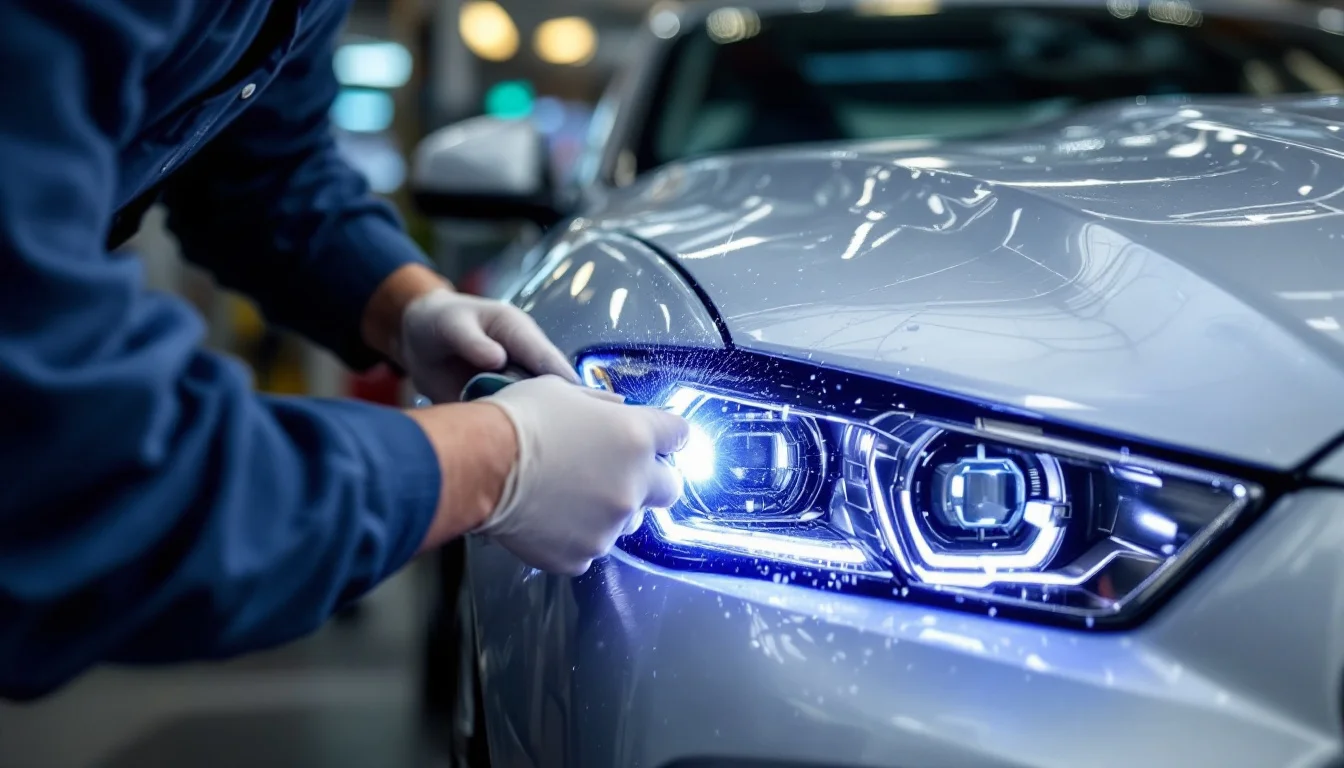
For decades, automotive headlights were manufactured from heavy, shatter-prone glass. Today, automotive engineering has shifted almost entirely to modern plastics. Most modern car headlights use polycarbonate plastic, while older vehicles, specific trucks, vans, and classic cars may still rely on glass. Because of its lighter weight and superior impact resistance, polycarbonate headlight lenses equip the vast majority of vehicles on Belgian and European roads today.
However, this modern engineering solution comes with a severe, hidden vulnerability: structural degradation caused by constant exposure to ultraviolet light. Over time, the factory-applied protective layer on polycarbonate lenses breaks down, leaving the raw plastic fully exposed to solar radiation, road salt, and harsh weather conditions.
What many drivers mistakenly perceive as simple surface dirt or superficial cloudiness is actually a chemical yellowing of the lens material itself. This degradation creates a scattering effect, blocking light from illuminating the road ahead. As vehicle components become increasingly complex and expensive, addressing this polycarbonate failure is no longer just a matter of cosmetic detailing—it can be a critical requirement for nighttime safety and avoiding technical inspection failures when light output is significantly affected.
Key Takeaways
- Financial impact: Preventative restoration helps drivers avoid replacing functional OEM headlight assemblies.
- Technical testing: Degraded lenses cause beam scattering, which can lead to potential technical inspection failure if light output is significantly affected.
- Methodology gap: Professional restoration utilizes mechanical polishing and industrial-grade curing that heavily outperforms basic manual sanding.
- Long-term durability: Advanced ceramic and UV treatments provide multi-year protection, vastly exceeding the short lifespan of consumer-grade sealants.
The Inspection Challenge: Why Cloudy Lenses Cost More Than You Think
Failing a vehicle technical inspection due to poor illumination often triggers unexpected expenses. Technical inspections evaluate beam patterns to ensure vehicles do not blind oncoming traffic while adequately illuminating the roadway.
Under standard vehicle inspection guidelines, cloudy or heavily deteriorated headlights can lead to potential inspection failure if light output is significantly affected. A scattered light pattern caused by clouded polycarbonate can therefore interfere directly with required roadway illumination.
The Shock of OEM Pricing
When faced with an inspection failure for clouded lenses, drivers often assume they must replace the entire unit. New OEM headlight assemblies often cost between €300 and €800 or more per side, plus fitting costs.
Replacing the entire unit is inefficient when the internal housings, mechanical seals, and complex electronics are still perfectly sound. Professional restoration is priced from €109.00 for a single lens, or €189.00 for a pair (reflecting combined setup and curing processes) at SHINES in Ingelmunster, Belgium, offering an alternative to standard replacements.
The LED Cost Factor
The technological shift toward sealed LED lighting has driven replacement prices even higher. While traditional halogen bulbs are generally inexpensive to replace, a complete headlight unit for a modern vehicle equipped with complex LED technology can often cost nearly a thousand euros. This steep contrast clearly illustrates the scale of the cost gap between restoring an existing housing and replacing a complex LED assembly.
If the external polycarbonate lens on a vehicle becomes oxidized, purchasing a full replacement simply to acquire clear plastic is a high cost to bear. Preventative restoration allows drivers to salvage the expensive internal LED matrix by simply repairing the external shield. The final restoration price depends on headlight size, condition severity, and the chosen service method—whether via garage visit, mobile service, or mail-in.
Safety Benchmarks: The 100-Metre Rule
Beyond financial penalties of inspection failures, clouded polycarbonate presents a profound physical hazard during nighttime driving or severe weather. The external degradation of the plastic casing actively works against the vehicle's internal light sources, dangerously reducing the time available to react.
Establishing the Safety Threshold
To quantify the danger of reduced visibility, we can look to general traffic safety concepts. For example, some international guidelines advise that visibility is seriously reduced when a driver can see less than 100 metres ahead. While specific legal definitions vary by country, this 100-metre distance serves as a useful conceptual benchmark for required forward visibility.
If a vehicle's headlights are so heavily yellowed that the beam cannot penetrate the darkness to a safe distance, the driver is operating the vehicle outside of safe parameters.
Internal Wear vs. External Degradation
Achieving adequate nighttime visibility requires both a functioning internal bulb and a clear external lens. Headlight bulbs dim over time through natural wear and tear. Standard halogen bulbs typically have a limited lifespan that varies by manufacturer, whereas modern LED systems are designed to last significantly longer, often operating for tens of thousands of hours.
However, investing in a vehicle with a long-lasting LED system yields no practical advantage if the external casing is heavily oxidized. The degraded polycarbonate absorbs and scatters the intense LED light before it ever reaches the asphalt. Maintaining the external clarity of the lens is essential to unlocking the full safety potential and intended lifespan of modern automotive lighting.
The Headlight Trilemma: DIY vs. Pro Polish vs. Full Replacement
When headlights fail due to oxidation, drivers generally face three distinct paths: attempting a home repair, hiring a professional restorer, or purchasing a complete replacement. Understanding the precise boundaries between these options is vital for avoiding wasted money and guaranteed re-oxidation.
| Approach | Upfront Cost Profile | Expected Longevity | Technology & Methods Used | Ideal Use Case |
|---|---|---|---|---|
| DIY Restoration Kits | Very Low (Cost of materials) | 3 to 6 months | Manual sanding (2-3 grits), basic buffing pad, consumer polish | Temporary aesthetic fix before a quick sale. |
| Professional Restoration | Moderate (€189.00 for both lenses) | 2 to 3 years | Calibrated mechanical polisher, 4-5 progressive grits, pro-grade compounds, ceramic/UV coating | Daily drivers needing to pass inspection with sound internal housings. |
| Full OEM Replacement | Extreme (€300–€800+ per side) | Lifespan of vehicle | Brand new sealed polycarbonate, pristine factory UV coating, new internals | Severe physical damage, deep cracks, or melted plastics. |
The Limitations of DIY Treatments
The consumer market is flooded with inexpensive restoration boxes, but the technical gap between these consumer products and professional tools is vast. A typical DIY headlight restoration kit comes with only 2 to 3 different grits of sandpaper, a basic buffing pad, and some standard polish.
Because DIY kits rely on manual application and limited abrasives, they often fail to completely remove the degraded factory coating, leaving microscopic layers of oxidized plastic behind. In contrast, a professional works with a calibrated mechanical polisher, 4 to 5 progressive grits of sandpaper, professional-grade polishing compounds, and a high-quality ceramic or UV-resistant coating.
The Longevity Multiplier
The difference in applied methodology directly translates to the lifespan of the repair. A DIY kit with included sealant typically delivers only 3 to 6 months of clarity. Without an industrial-grade UV barrier, the newly exposed plastic quickly re-oxidizes.
Conversely, a professional ceramic treatment lasts 2 to 3 years. This durability factor is 4 to 10 times longer than the amateur approach, fundamentally altering the return on investment over the vehicle's life.
When Replacement is Inevitable
While professional restoration is highly effective, it cannot perform miracles on compromised structural integrity. SHINES defines the precise limits of the service: technicians can remove exterior oxidation, yellowing, cloudiness, haziness, discoloration, and light to moderate scratches on polycarbonate lenses.
However, cases involving deep cracks, chips that penetrate through the lens, or badly melted plastic push past the limits of surface restoration. In these specific scenarios of structural failure, purchasing a replacement assembly becomes strictly necessary to prevent moisture ingress and electrical failure.
What Happens in a Professional Restoration Bay?
Professional restoration utilizes a rigorous, multi-stage industrial process designed to completely remove the failed factory layer, rather than just temporarily masking the haze.
The Refinement Process
The professional restoration process on polycarbonate lenses follows strict operational steps. Technicians first inspect each lens to assess the depth of the degradation. Next, they meticulously mask the surrounding paint to protect the vehicle's bodywork from mechanical friction.
The most critical step is to physically shave down the degraded plastic until raw, healthy polycarbonate is reached. Technicians then refine the lens to a perfectly smooth, coating-ready finish using progressively finer abrasives.
Industrial Curing Capabilities
Once the lens is perfectly clear, it has zero natural defense against the sun. To solve this, technicians apply an OEM-grade UV hard coat.
The operational advantage of a professional bay lies in how this final coat is processed. The sealant is cured with concentrated ultraviolet light in the shop, allowing the coating to rapidly achieve a high degree of functional hardness by the time of handover.
For drivers, this means there is no need to keep the car safely parked in a dust-free garage overnight while chemicals slowly air-dry. Furthermore, there is no restriction before the vehicle can face heavy rain or automated washing, making the professional route highly practical for everyday commuters.
Frequently Asked Questions (FAQ)
Does exterior restoration fix internal moisture or condensation issues?
No. Condensation inside the headlight housing indicates a failure of the mechanical seals or a crack in the casing allowing water ingress. Exterior polishing only addresses surface oxidation on the outside of the polycarbonate. Resolving internal moisture requires unsealing the unit, drying it out, and applying new waterproof sealants.How long does a professional restoration process take?
SHINES states that local restorations are typically completed in 45–90 minutes for both headlights, depending on size and oxidation severity, with the coating fully hardened before the driver leaves.Is there a warranty or guarantee on the new UV coating?
Yes. Every SHINES restoration includes a 1-year clarity guarantee, and the company claims results typically last years rather than months because the failed UV layer is stripped and a professional hard coat reapplied.Can front fog lights be restored using this same methodology?
Yes, provided the fog light housings are manufactured from modern polycarbonate plastic rather than traditional glass. Many modern vehicles use the exact same materials for lower auxiliary lighting, making them entirely suitable for progressive mechanical sanding and UV hard-coat applications.Conclusion: A Shift in Vehicle Maintenance
As automotive manufacturers continue to integrate highly complex matrix LED technology into sealed monolithic units, the era of the simple and cheap headlight swap is definitively over. The external polycarbonate shell is now the sole line of defense for internal components that can cost nearly a thousand euros to replace. This shift means technical inspection regimes will likely encounter more costly failures tied to external oxidation rather than simple bulb burnouts. Maintaining exterior lens clarity will increasingly dictate the residual value of used vehicles, as buyers and inspectors alike recognize that clear polycarbonate is strictly necessary to protect and preserve expensive modern lighting systems.