Touchless vs. Brush Car Wash: The Paint Trade-Off
Introduction
The automated car wash represents a maintenance decision with trade-offs rather than a simple maintenance chore. The defining factor in this shift is the evolution of factory clear coats. While modern automotive clear coats offer superior chemical and UV resistance, they are applied in thinner layers than historical systems and require careful maintenance to prevent mechanical scratching in brush-based car wash systems.
Because modern vehicle surfaces offer a smaller margin for error, selecting the appropriate washing method requires understanding exactly how automated systems operate. The debate between traditional friction washes and modern touchless alternatives is no longer a generic discussion of which is "better." Instead, it represents a choice between different forms of wear.
Vehicle owners must now choose between mechanical abrasion—where physical friction poses an ongoing threat to clear coats—and harsh chemical action, where high-strength cleaning agents challenge the integrity of organic waxes and sealants. Making the right decision depends entirely on understanding both the mechanisms of the wash and the specific protective infrastructure on the vehicle's exterior.
Key Takeaways
- Touchless washes are ideal for ceramic-coated, dark-colored, and wrapped vehicles to avoid physical abrasion.
- Soft-touch washes are often necessary to safely agitate and remove heavy dirt and grime from standard finishes.
- Harsh chemicals in touchless systems can degrade natural waxes and sealants, requiring frequent reapplication.
- Brush-based washes carry a risk of micro-marring due to road grit transferred from previous vehicles.
The Mechanics of Friction: How Does Soft-Touch Handle Grit Transfer?
Automated friction washes rely on physical contact to dislodge contaminants from the vehicle's exterior. This mechanical approach remains the industry standard for sheer cleaning power, but it introduces distinct physical risks to modern, thinner paint systems.
The Action of Spinning Brushes
A soft-touch car wash uses spinning foam brushes made of cloth or plastic bristles that rotate quickly and press against the vehicle, removing dirt through direct contact and friction. Modern brush materials are designed to be gentler than older bristles and to glide over panels. However, the fundamental mechanism—rapid, repetitive physical striking against the clear coat—remains unchanged.
The Grit Transfer Threat
The primary danger of a soft-touch system does not necessarily come from the brushes themselves, but from what they carry.
- Contaminant accumulation: Brushes in a soft-touch wash contact hundreds of vehicles before yours.
- Abrasive dragging: They pick up sand, road grit, and debris from heavily soiled vehicles.
- Surface damage: These trapped particulates are then dragged across your paint.
The Chemistry of Touchless: What Happens When Pressure Replaces Brushes?
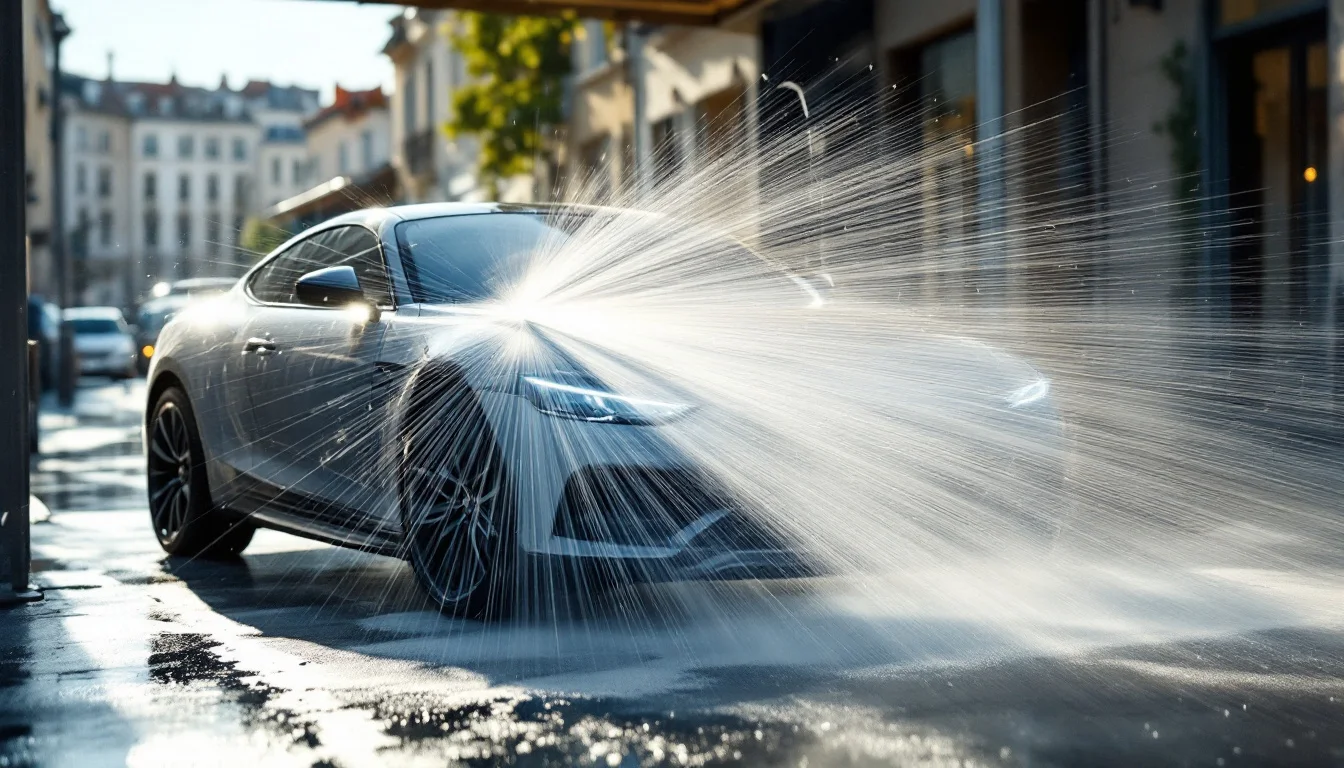
To eliminate the risk of physical abrasion and grit transfer, a touch-free car wash cleans without any physical contact, using high-pressure water jets and specially designed cleaning agents to loosen grime and break down contaminants.
Hydraulic Force and Polymer Chemistry
Removing road film, baked-on brake dust, and organic matter without a physical brush requires significant hydraulic power. Modern touchless systems combine intense, highly variable water pressure in the high-pressure rinse stage with polymer chemistry.
This combination functions through a precise sequence:
- Pre-soaking: The system coats the vehicle in specialized detergents designed to break the molecular bonds holding dirt to the clear coat.
- Dwell time: The chemicals are left to sit, lifting the particulates away from the surface.
- Hydraulic shearing (rinse): The high-pressure water jets blast the loosened contaminants away, utilizing sharp spray angles to maximize mechanical force without solid contact.
The Downside of Frictionless Cleaning
The elimination of spinning foam brushes forces touchless systems to rely heavily on chemical action to achieve a clean surface. Because a touchless wash touches no part of the vehicle with brushes or cloth strips, harsher chemicals are required to get the job done.
Some specialized cleaning agents operate at extreme ends of the pH scale—utilizing highly alkaline soaps to dissolve organic matter and acidic solutions to neutralize minerals—although many modern systems now incorporate advanced, pH-neutral surfactants. While effective at substituting the mechanical action of a brush, this chemical intensity introduces a new set of vulnerabilities for vehicle owners who rely on aftermarket surface protections.
Chemicals harsh enough to remove road grime without friction can sometimes strip away wax and paint sealant. Depending on the residual concentration, contact time, and effective surface pH, natural carnauba waxes and basic polymer sealants may not withstand repeated exposure to these chemical solutions. Over time, the protective layers designed to shield the bare paint can be dissolved, leaving the clear coat more exposed to environmental damage if the owner does not regularly reapply them. Note, however, that commercial operators with vested interests dispute this, arguing that advances in touchless chemistry have made such concerns largely outdated.
Decoding Operator Claims: Which System Does Your Car Need?
Navigating the automated car wash landscape requires looking past conflicting marketing claims to understand the fundamental physics at play. Commercial operators frequently present their chosen technology as a flawless solution, but comparing industry statements highlights an unavoidable trade-off.
On one side, operators utilizing modern friction systems downplay the risks of abrasion. Some proponents argue that both the fear of spinning brushes leaving swirl marks and the fear that touchless chemicals are too harsh are outdated myths, attributing the change to advanced materials and smarter chemistry. They position contemporary soft-touch systems as entirely safe for modern paints.
Conversely, other industry voices highlight the distinct vulnerabilities of competing systems. Some explicitly warn that the harsh chemicals required in touchless systems can strip away wax and paint sealant. Meanwhile, soft-touch systems still face the reality that brushes can pick up sand, road grit, and debris from previous vehicles, potentially dragging them across the paint and slowly damaging the clear coat.
While advanced foam is gentler than older materials, and smarter chemistry is more refined than the aggressive detergents of the past, the core mechanisms remain unchanged. Vehicle owners cannot completely avoid wear; they must simply choose whether their specific vehicle is better suited to withstand physical friction or chemical degradation.
Beware the Terminology: What Does 'Brushless' Really Mean?
Before selecting a washing strategy, vehicle owners must carefully navigate industry terminology, which is frequently designed to obscure the actual mechanical processes inside the tunnel.
The label 'brushless' is particularly ambiguous and varies across markets: some car washes use it to mean fully touch-free with no contact at all, others use it for soft-cloth washes that replaced stiff brushes with foam or cloth strips that still touch the paint, and some use it to describe hybrid soft-touch systems with a high-pressure pre-rinse.
This ambiguity can lead to unintended damage. A vehicle owner seeking a chemically-driven wash to protect a delicate wrap might see a "brushless" sign, only to enter a tunnel where heavy cloth strips physically drag across the vehicle's surface. To protect specialized finishes, drivers must look past the signage and visually confirm whether the system relies solely on high-pressure water jets (touchless) or if physical materials hang in the washing bay (soft-touch/brushless).
The Surface Matching Framework: Which Wash Does Your Car Actually Need?
Because neither mechanical nor chemical washing systems are universally flawless, the optimal choice depends entirely on the vehicle's surface infrastructure. By matching the wash mechanism to the specific vulnerabilities of the paint or coating, owners can minimize long-term degradation.
1. Ceramic-Coated Vehicles
Modern ceramic coatings offer significant hardness and chemical resistance, but they have distinct physical limitations. Even a ceramic coating cannot fully protect against repeated abrasion from brush-based car wash systems.- Vulnerability: Micro-marring from grit transfer.
- Resistance: Ceramic coatings generally tolerate touchless chemistry better than bare wax or polymer sealants, though the degree of resistance varies by product and concentration; periodic inspection is still advisable.
- Recommendation: Touchless washes are preferred. The coating sheds dirt easily under high water pressure.
2. Vinyl Wraps and Paint Protection Film (PPF)
Aftermarket films completely alter the washing equation. Vinyl wraps and paint protection films can be damaged by mechanical friction.- Vulnerability: Physical lifting and tearing.
- Risk factors: Brush-based washes can peel wrap edges, create air bubbles, and scratch delicate custom finishes.
- Recommendation: Touchless washing cleans these special surfaces safely, and many auto detailing experts recommend it for wrapped vehicles. High-pressure water must be applied with care at close range, but avoiding the physical dragging of cloth strips is essential to preserve wrap seams and edges.
3. Heavily Soiled Traditional Paint
For standard factory clear coats covered in mud, heavy road salt, or baked-on organic matter, chemical action alone is frequently insufficient.- Vulnerability: Deeply bonded contaminants that water pressure alone cannot break.
- Recommendation: Choosing a soft cloth wash may be necessary to power through heavy dirt and grime. In these scenarios, the mechanical friction of the spinning foam brushes can be necessary to agitate and remove the caked-on layer, even if it carries a minor risk of micro-marring. Owners must simply be prepared to reapply waxes or sealants periodically.
4. Darkly Colored Finishes
Black, dark blue, and deep red factory paints highlight micro-marring more intensely than lighter colors.- Vulnerability: High visibility of clear coat scratches caused by grit transfer.
- Recommendation: A touchless wash is explicitly recommended when the main goal is protecting a delicate finish such as a dark color. Minimizing physical contact preserves the optical depth of the paint, provided the owner maintains a robust sealant layer to counter the harsher chemistry.
Conclusion: How Does Washing Fit Into Paint Management?
The automated car wash functions as one component in a broader paint management strategy rather than a standalone service. By recognizing that modern factory clear coats are applied in thinner layers than historical standards, owners can acknowledge that no wash is completely consequence-free. This practical reality turns wash selection into a long-term maintenance cycle decision: determining how often you are willing to reapply wax and sealants versus how often you are willing to undergo professional paint correction. Preserving a vehicle's exterior ultimately requires analyzing the specific surface finish—whether ceramic, vinyl, or bare paint—and intentionally balancing the trade-offs between chemical exposure and mechanical friction.